



Dr. Drew Dickson, refractive surgeon and PCEO at Modern Vision Centers, walked WHO13’s Hello Iowa through the practice’s EyeAnalysis exam in West Des Moines. A reporter went through the full eye test and evaluation firsthand, describing it as feeling like a photo shoot as a technician guided her through machine after machine. Dickson used the segment to explain what each test is actually looking for, and how each is a piece of the puzzle in determining the right vision correction procedure for each patient.
Why does Modern Vision Centers run so many tests before vision correction surgery?
Each test exists to answer a specific question about a patient’s eyes. “We wanna know as much about your eyes as possible if we’re talking about doing surgery on them,” Dickson said. The goal is catching anything that could affect candidacy before a procedure is ever scheduled, then narrowing down which of the seven options Modern Vision Centers offers fits best.
That approach shapes the exam’s length and depth. A single test might rule a patient in for one procedure and out for another, and layering multiple tests together catches things a standard eye exam would miss. Dickson described the exam as covering “everything from the front of the eye to the back of the eye” for exactly that reason.
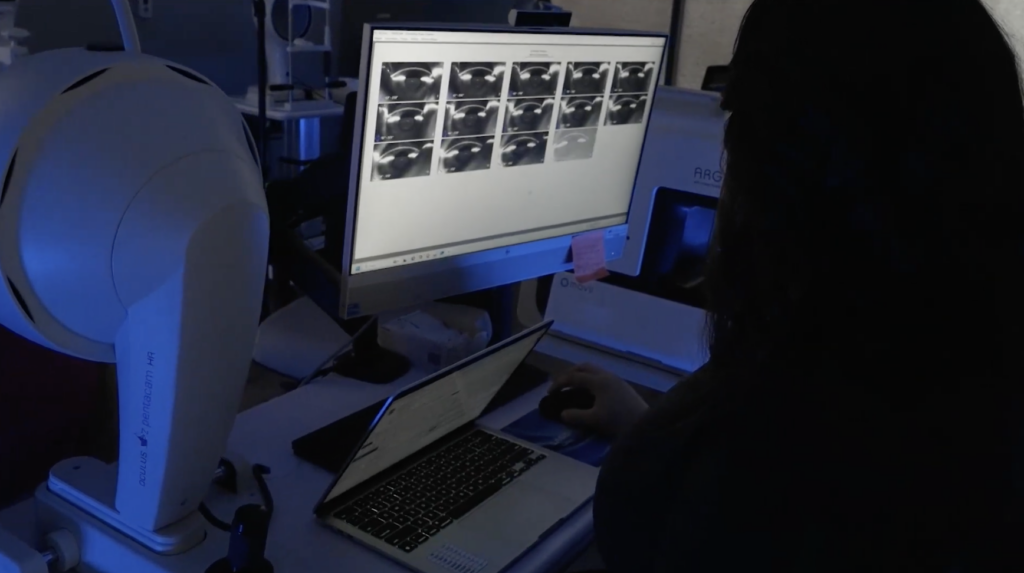
What does the Pentacam test check for?
The Pentacam maps the shape, thickness, and astigmatism of the cornea. Dickson compared the readout to “a topographic map of like the Rocky Mountains,” giving his team a detailed view of the eye’s front surface. This test factors into nearly every procedure Modern Vision Centers performs, and Dickson called it especially important for LASIK, SMILE, and PRK specifically, since corneal shape and thickness affect how safely those procedures can be done.
What does epithelial mapping add beyond the Pentacam?
Epithelial mapping looks specifically at the cornea’s very front surface, a layer the Pentacam doesn’t isolate on its own. Dickson said this test “can tell us when there’s any early problems going on,” which helps rule certain procedures in or out with more precision than the Pentacam alone provides. Software built into the Pentacam also screens for patients who may carry a higher risk of complications with LASIK, which is part of why alternatives exist for patients who don’t screen well for it.
What does wavefront analysis look for?
Wavefront analysis tracks how light moves through the eye, flagging irregularities before surgery happens. Dickson explained that this test can indicate whether a patient may be more prone to glare or halo symptoms after a procedure. Catching that risk ahead of time gives Dickson’s team a chance to steer a patient toward a procedure less likely to produce those symptoms for their specific eyes.
What does the OCT scan check for?
The OCT scan produces a cross-section through the eye’s internal structures, checking thickness at the retina and optic nerve. Dickson said this test can detect problems with the retina or optic nerve independent of whether a patient is even a surgery candidate. Some of this same data, including eye length and corneal steepness, also helps the practice plan for cataract surgery years before a patient might need it. The full EyeAnalysis exam at Modern Vision Centers runs each of these tests, plus several others, in a single visit.
No single test tells the whole story on its own. The Pentacam, epithelial mapping, wavefront analysis, and OCT scan each catch something different, and together they give Dickson’s team the detail needed to match a patient in West Des Moines, Iowa, to the procedure that actually fits their eyes. Modern Vision Centers marked one year in West Des Moines this summer, with an anniversary event held July 9th.
Call Modern Vision Centers at 515-674-2020 or visit mvcvision.com to schedule an EyeAnalysis.