



If reading glasses have become part of your everyday life, or your prescription keeps changing as you get older, Refractive Lens Exchange (RLE) may be the long-term solution you have been looking for. RLE replaces the eye’s natural lens with an advanced intraocular lens to correct your vision and prevent cataracts from ever developing. Because it is an elective eye surgery, one of the first questions patients in Des Moines, Iowa ask is how much it costs. The answer depends on several factors, including the lens you choose, the technology used, and the skill and experience of your surgeon. At Modern Vision Centers, we believe in transparent pricing, so you have the information you need to make a confident decision. In this article, we explain what RLE typically costs in the Des Moines area and what is included in the price, as well as how to receive your personalized quote.
How Much Does RLE Cost in Des Moines?
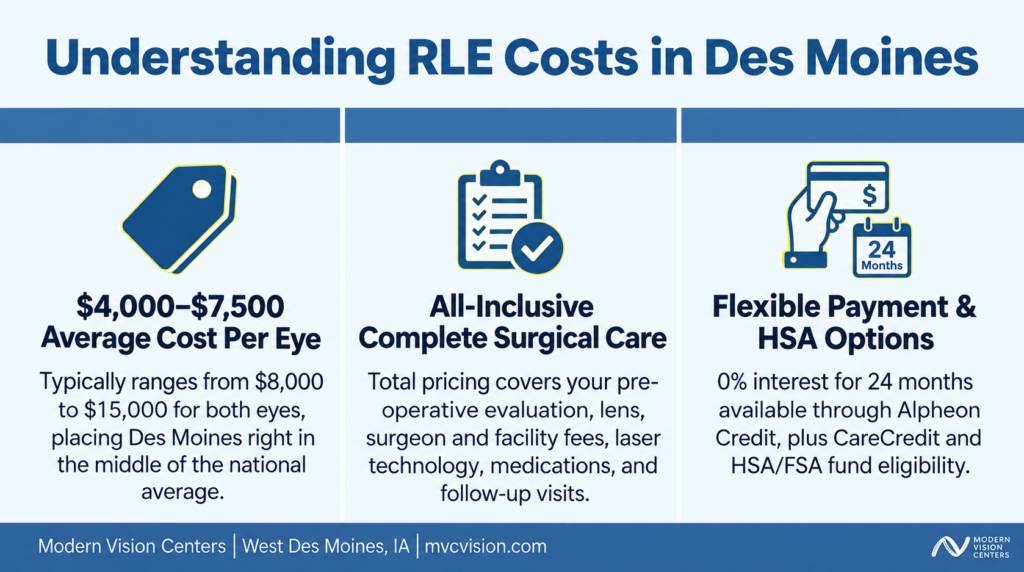
In the Des Moines area, RLE typically costs between $4,000 and $7,500 per eye, or roughly $8,000 to $15,000 for both eyes, depending on the intraocular lens you choose. Across the United States, the average cost of lens replacement surgery ranges from about $3,400 to more than $11,700 per eye, with the type of lens being the biggest factor in the final price. Midwest markets like Des Moines generally fall in the middle of that national range.
A complete RLE price should include more than the lens itself. It typically covers your pre-operative evaluation, the intraocular lens, the surgeon’s fee, the surgical facility fee, the laser and diagnostic technology used during your procedure, medications, and follow-up visits. Before comparing quotes, ask each practice for a full breakdown so you know exactly what you are paying for. At Modern Vision Centers, we provide a personalized price estimate during your consultation so there are no surprises.
To make RLE more manageable, Modern Vision Centers offers financing through Alphaeon Credit and CareCredit. With an Alphaeon credit card, patients pay no interest when the balance is paid in full within 24 months (terms and conditions apply). Many patients also use HSA or FSA funds to cover part or all of their surgery.
How Does My Lens Choice Affect the Price of RLE?
The intraocular lens you choose has the biggest impact on the cost of your procedure. At Modern Vision Centers, lens selection is all about personalization. Our surgeons (Dr. Drew Dickson and Dr. Brandon Menke) recommend the best option for your eyes, your prescription, and the way you want to see in everyday life. Our lens options include:
Toric lenses, which correct astigmatism for sharper vision without relying on glasses.
Extended Depth of Focus (EDOF) lenses, which provide a smooth, continuous range of vision from far to intermediate distances.
Multifocal and trifocal lenses, which are designed to give patients the fullest range of vision at near, intermediate, and far distances.
Light Adjustable Lenses, which allow us to fine-tune the lens power after surgery using UV light, a helpful option for patients who have had LASIK in the past.
Blended Vision lenses, which set one eye for distance and the other slightly for near, similar to monovision contact lenses.
Advanced lenses that reduce your need for reading glasses generally cost more than a basic lens, but they are also what make RLE such a meaningful upgrade for most patients. During your evaluation, we will explain the price of each option that fits your eyes so you can choose based on your goals and budget.
Can RLE Save Me Money on Glasses and Contacts?
For many patients, yes. After age 45, most people find that one pair of glasses is no longer enough. Progressive or bifocal glasses typically cost $250 to $500 or more per pair and are often replaced every one to two years. Add readers, prescription sunglasses, contact lenses, and yearly exams, and the cost of corrective lenses adds up quickly over the next two decades.
RLE is a one-time cost. Because the intraocular lens does not age or cloud over, your result stays stable for the rest of your life, and you will never need cataract surgery. For many patients, the real value is in the details of everyday life, like reading a menu at a favorite East Village restaurant, checking a phone at the Des Moines Farmers’ Market, or seeing clearly on the drive home without reaching for a second pair of glasses.
Should I Wait for Medicare to Cover Cataract Surgery Instead?
This is one of the most common questions we hear, and the answer often surprises patients. Medicare covers basic cataract surgery with a standard monofocal lens, which typically costs about $380 to $590 per eye out of pocket after the deductible. However, a standard lens usually still requires glasses for many tasks. Patients who want the same range of vision RLE provides typically pay an additional $1,500 to $4,000 or more per eye to upgrade to a premium lens.
When you combine those upgrade costs with the years of glasses and progressive lenses you would buy while waiting, the price difference between RLE now and cataract surgery later is often smaller than it first appears. RLE also gives you clear vision for years or even decades longer. During your consultation, our team can walk you through this comparison using your age and vision needs.
Does Insurance Cover RLE in Iowa?
Because RLE is an elective procedure, most health insurance plans and Medicare do not cover it. If you already have a cataract that is affecting your vision, insurance may cover part of the cost of lens replacement surgery. Your evaluation will tell us whether that applies to you.
Many patients use pre-tax dollars from a Health Savings Account (HSA) or Flexible Spending Account (FSA) to pay for RLE. For 2026, you can contribute up to $3,400 to a health FSA, and each spouse with their own FSA through work can contribute up to that amount. Since many employers hold open enrollment in the fall, now is a good time to plan ahead if you are considering RLE next year.
Your Clear Vision Starts Here
Take the first step—see if you're a candidate now.
Why Does RLE Cost More Than LASIK?
RLE generally costs more than LASIK because it involves replacing the lens inside the eye with an advanced intraocular lens, rather than reshaping the cornea with a laser. The procedure is similar to cataract surgery. Through a tiny incision, the natural lens is gently removed using advanced laser and ultrasound technology, and a custom lens is placed in its place. The price reflects the cost of the lens, the surgical technology, and the expert skill required to perform this type of eye surgery.
For patients over 45, RLE also offers benefits LASIK cannot. LASIK corrects near-sightedness, farsightedness, and astigmatism, but it does not address the aging lens that causes reading problems and eventually leads to cataracts. RLE corrects your vision at every distance and removes the lens that would otherwise develop a cataract, so it solves today’s vision problems and tomorrow’s at the same time.
Is RLE Worth the Cost for Des Moines Patients?
For the right candidate, RLE is one of the most complete vision correction procedures available. It corrects your vision at multiple distances, reduces or eliminates the need for glasses, and means you will never need cataract surgery. With transparent pricing, flexible financing, and an expert surgical team, Modern Vision Centers makes the process simple from your first visit to your final result.
If you are ready to see life clearly, schedule a consultation at Modern Vision Centers and start your journey to visual freedom.
FAQs About RLE Cost in Des Moines
What factors affect the price of RLE in Des Moines?
The main factors are the type of intraocular lens you choose, the surgeon’s experience and skill, the technology used during your evaluation and procedure, and what is included in the quoted price. Some practices list the surgeon’s fee and facility fee separately, while others include everything in one price. At Modern Vision Centers, we review every part of your cost during your consultation.
Is RLE priced per eye or for both eyes?
RLE is usually quoted per eye. Because most patients have both eyes treated on the same day, it helps to ask for the total cost for both eyes. In the Des Moines area, that total typically falls between $8,000 and $15,000, depending on your lens choice.
Does the cost of RLE change if I have astigmatism?
It can. Patients with astigmatism may need a toric lens, which is designed to correct astigmatism along with near-sightedness or farsightedness. Toric and other advanced lenses typically cost more than a standard lens. Your evaluation will determine which lens is right for you.
Are there hidden fees I should ask about?
When comparing quotes, ask whether the price includes your pre-operative evaluation, facility fee, laser technology, prescription eye drops, and all follow-up visits. It is also worth asking whether any enhancements are included if a small adjustment is needed after surgery. At Modern Vision Centers, we believe in transparent pricing and will share this information upfront.
Can I finance RLE at Modern Vision Centers?
Yes. We offer financing through Alphaeon Credit and CareCredit. With an Alphaeon credit card, you pay no interest when your balance is paid in full within 24 months (terms and conditions apply). Many patients combine financing with HSA or FSA funds to lower their monthly payments.
How long is recovery after RLE?
The procedure takes about 10 to 15 minutes per eye, and both eyes are typically treated on the same day. Most patients notice improved vision within a few days, feel comfortable driving the next day, and return to normal routines within about 48 hours. Your vision continues to sharpen over the following weeks, with final results stabilizing within a couple of months.
Will I still need reading glasses after RLE?
The goal of RLE is to reduce or eliminate your need for glasses, including for reading. Multifocal, trifocal, and EDOF lenses are designed to provide clear vision at a range of distances, though results vary from patient to patient. During your consultation, we will talk about the tasks that matter most to you and recommend the lens most likely to meet your goals.
Is RLE a permanent solution?
Yes. The intraocular lens used in RLE does not age, cloud over, or wear out, so your vision correction is long-lasting. Because your natural lens is removed, you will never develop a cataract, which means you will not need cataract surgery later in life.
Sources
CareCredit. “Lens Replacement Surgery Cost and Procedure Guide.” https://www.carecredit.com/well-u/health-wellness/lens-replacement-surgery-cost/
Kugler Vision. “Is Refractive Lens Exchange Cheaper Than Waiting for Cataracts? The Cost-Benefit Timeline No One Discusses.” https://lasikomaha.com/is-refractive-lens-exchange-cheaper-than-waiting-for-cataracts-the-cost-benefit-timeline-no-one-discusses/
Gelman Vision. “Is RLE Covered by Insurance? Vision Correction Financing.” https://gelmanvision.com/is-rle-covered-by-insurance-vision-correction-financing
NFP. “IRS Announces 2026 Health FSA, Other Benefit Limits.” https://www.nfp.com/insights/irs-announces-2026-benefit-limits/
Modern Vision Centers. “Refractive Lens Exchange.” https://www.mvcvision.com/refractive-lens-exchange/
Modern Vision Centers. “Financing.” https://www.mvcvision.com/financing/
Medically Reviewed By:
Drew Dickson, MD, PCEO
Board-Certified Ophthalmologist
Fellowship-Trained Refractive Surgeon, WCRS
Last reviewed October 8, 2026