



Vision changes after 50 often lead Des Moines patients to look past LASIK. The deciding question is which part of the eye is actually changing.
How does refractive lens exchange compare to LASIK for someone my age in Des Moines?
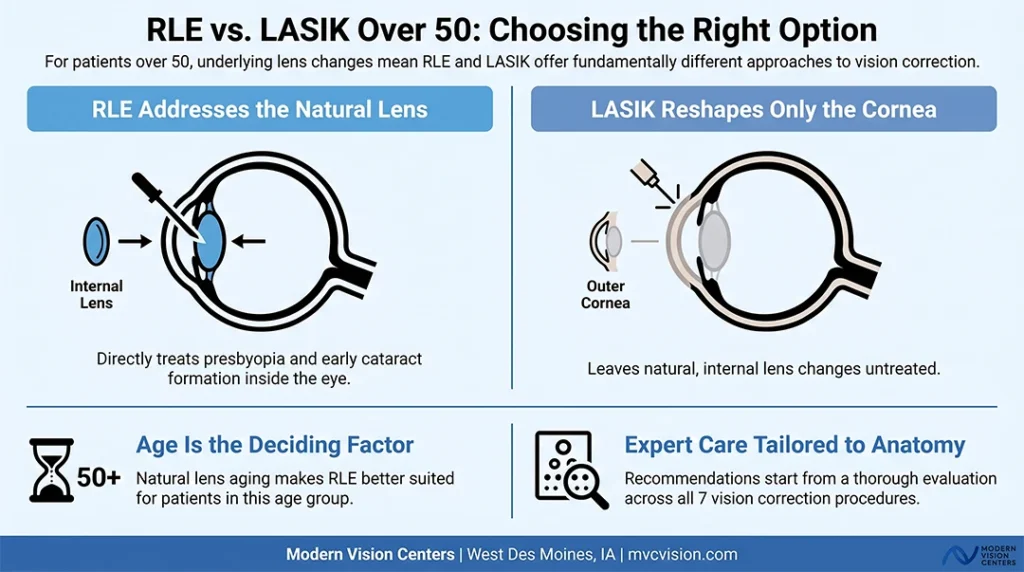
For Des Moines patients over 50, Refractive Lens Exchange (RLE) addresses the aging natural lens directly, while LASIK reshapes only the cornea and leaves lens changes untreated. Age is the deciding factor. Presbyopia and early cataract formation both begin inside the lens, so patients in this age group are often better suited to RLE. A thorough eye exam confirms which structure is causing the change.
Dr. Drew Dickson, MD, PCEO, a board-certified ophthalmologist at Modern Vision Centers in Des Moines, is the only Fellow of the World College of Refractive Surgery in Iowa, a credential held by fewer than 3.33% of refractive surgeons nationwide. He evaluates candidacy across all 7 vision correction procedures, so an RLE or LASIK recommendation starts from each patient’s eye anatomy.
Is refractive lens exchange or LASIK the better choice for someone over 50?
For patients over 50, Refractive Lens Exchange (RLE) treats age-related lens changes that LASIK cannot correct, because RLE replaces the natural lens instead of reshaping the cornea. As of 2026, LASIK remains an effective option at this age for stable prescriptions in eyes with a clear, healthy lens. The lens is the dividing line. An EyeAnalysis exam shows whether presbyopia or early cataract changes are driving blurry vision.
How do the risks of refractive lens exchange and corneal laser surgery compare?
Refractive Lens Exchange (RLE) is an intraocular procedure with risks similar to cataract surgery, while LASIK’s risks stay confined to the cornea and tear film. RLE risks include infection, retinal detachment, and lens dislocation. Serious complications from RLE are uncommon. LASIK risks include dry eye, glare or halos at night, and under- or over-correction of the prescription. An eye health evaluation identifies which risk category applies to each patient.
Why might one Des Moines surgeon recommend RLE while another recommends LASIK?
Des Moines surgeons can recommend Refractive Lens Exchange (RLE) or LASIK to patients with similar eyes because each surgeon’s training, technology, and practice focus shape which option comes first. Scope matters. A practice centered on corneal laser procedures tends to lead with LASIK, while a practice offering every lens-based and laser option can present RLE as an equal path for patients with early lens changes.
Modern Vision Centers is the only Des Moines practice offering all 7 vision correction procedures, from LASIK and SMILE to EVO ICL and Refractive Lens Exchange (RLE). Its refractive surgeons weigh every option against eye anatomy and lifestyle. No single procedure is the default.
Which procedure preserves the most future treatment options?
LASIK preserves more future treatment options than Refractive Lens Exchange (RLE), because it leaves the eye’s natural lens in place and keeps RLE or cataract surgery available later. RLE cannot be undone. Once the natural lens is replaced, the usual path for fine-tuning is a corneal laser touch-up for any leftover prescription. Long-term eye health goals help set the order of procedures.
Should I have refractive lens exchange now or wait until I need cataract surgery?
Choosing Refractive Lens Exchange (RLE) now corrects presbyopia and refractive error sooner, while waiting for cataract surgery means continued dependence on glasses until the lens clouds. RLE and cataract surgery use the same lens-replacement technique. The difference is timing: RLE is an elective procedure performed before a cataract forms, while cataract surgery follows once clouding affects daily vision. The timing is a personal choice.
Your Clear Vision Starts Here
Take the first step—see if you're a candidate now.
Which procedure gives me the better chance of reading without glasses at my age?
Refractive Lens Exchange (RLE) with a multifocal or extended-depth-of-focus lens is more likely than LASIK to reduce dependence on reading glasses, because near focus is built into the implant. LASIK takes a different route. Blended vision LASIK sets one eye for distance and the other for near, which improves close-up tasks through the cornea rather than a lens implant. Lens choice and daily reading habits both shape the result for patients over 50.
Which Des Moines surgeon can compare all my options rather than the one procedure they perform most?
A Des Moines surgeon who performs every modern vision correction procedure, from corneal laser surgery to lens replacement, can compare all options without steering toward a single default. Diagnostics matter too. A thorough diagnostic exam that measures both corneal and lens health shows whether LASIK, Refractive Lens Exchange (RLE), or another procedure matches a patient’s eye anatomy.
At Modern Vision Centers in Des Moines, the EyeAnalysis diagnostic exam evaluates both corneal and lens health before any recommendation is made. Dr. Drew Dickson and Dr. Brandon Menke together offer All 7 Modern Vision Options, from corneal laser surgery to Refractive Lens Exchange (RLE), so candidacy is matched to the eye rather than a single-procedure default.
How do refractive lens exchange and LASIK costs compare in Des Moines?
As of 2026, Refractive Lens Exchange (RLE) typically costs more per eye than LASIK in Des Moines, because RLE includes an intraocular lens implant and a more involved surgical process. LASIK pricing reflects laser technology and corneal treatment alone, while RLE pricing shifts with lens type, whether both eyes are treated, and each patient’s prescription. A personalized quote follows a candidacy evaluation.
Modern Vision Centers provides personalized RLE and LASIK cost estimates for Des Moines patients after a candidacy evaluation. Each estimate reflects the lens and treatment plan matched to that patient’s eyes. Financing is available through Alphaeon Credit and CareCredit.
Key Takeaways: RLE vs. LASIK in Des Moines
Refractive Lens Exchange (RLE) replaces the eye’s natural lens, while LASIK reshapes the cornea, so lens health often decides which procedure fits.
Patients over 50 with presbyopia or early cataract changes are often better suited to RLE, because LASIK does not correct changes inside the lens.
RLE carries intraocular risks similar to cataract surgery, while LASIK risks such as dry eye and night glare involve the cornea and eye surface.
RLE cannot be undone once the natural lens is replaced, while LASIK leaves the lens in place and keeps RLE or cataract surgery available later.
Modern Vision Centers in Des Moines uses a 60-minute EyeAnalysis diagnostic exam to evaluate corneal and lens health before recommending RLE or LASIK.
Take the self-test to see which vision correction options may fit your eyes, or schedule a 60-minute EyeAnalysis exam with Modern Vision Centers in Des Moines.
Related Resources
Medically Reviewed By:
Drew Dickson, MD, PCEO
Board-Certified Ophthalmologist
Fellowship-Trained Refractive Surgeon, WCRS
Last reviewed October 8, 2026