



Cataract surgery restores clear vision, and it also lets you choose how you want to see for the rest of your life. During the procedure, your surgeon removes your eye’s clouded natural lens and replaces it with an artificial intraocular lens. The lens you choose has a lasting effect on how much you rely on glasses afterward. At Modern Vision Centers in West Des Moines, Iowa, we help every patient understand their premium cataract lens options so they can choose the one that fits their eyes, their goals, and their everyday life.
What Is a Premium Cataract Lens?
A premium cataract lens is an intraocular lens implant designed to do more than restore clear distance vision. A standard lens brightens vision and focuses at a single distance. Premium lenses add other benefits, such as correcting astigmatism, providing a range of vision from far to near, or allowing the prescription to be fine-tuned after surgery. The goal is to reduce, and in many cases eliminate, the need for glasses and other corrective lens options once you have healed.
At Modern Vision Centers, our surgeons focus exclusively on cataract and refractive surgery, so lens selection is a central part of every cataract consultation. Dr. Brandon Menke, MD, has completed thousands of cataract surgeries, and Dr. Drew Dickson, MD, PCEO, is the only World College of Refractive Surgery Fellow in Iowa. Together, they bring deep experience in matching the right lens to the right eye.
How Does a Premium Lens Compare to a Standard Monofocal Lens?
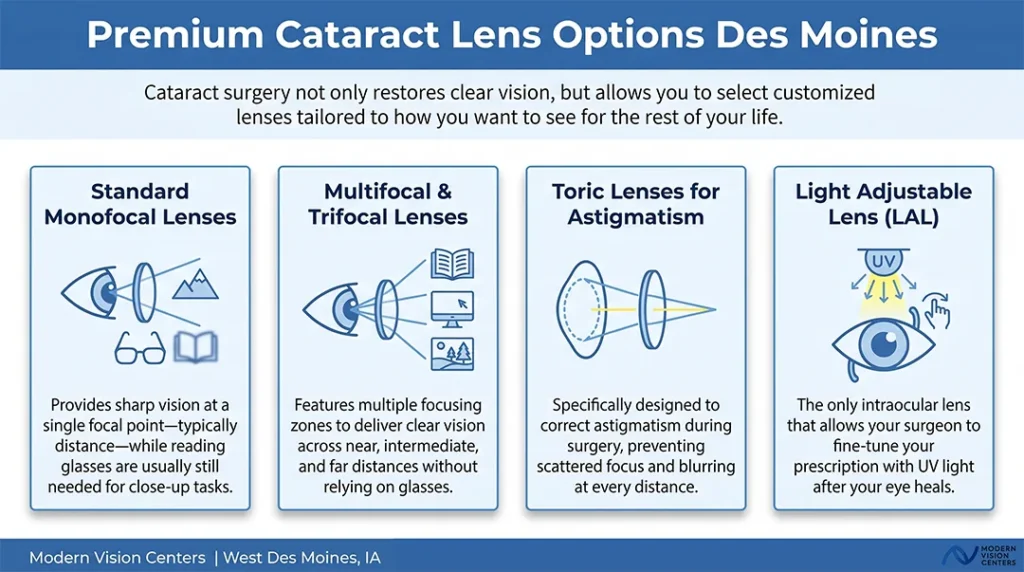
A monofocal lens provides sharp, high-quality vision at a single focal point, usually set for distance. Today’s monofocal lenses have an aspheric design that mimics the natural curvature of the eye, which improves clarity in low light, such as when driving at night. Most patients with a monofocal lens, however, still need reading glasses for close-up tasks.
Monofocal lenses remain a reliable choice for patients who don’t mind using readers and want the best possible distance vision. They also play an important role for patients with certain retina conditions. Premium lenses expand what cataract surgery can accomplish, and depending on the lens you choose, you may be able to read a menu, work on a computer, and drive with little or no help from glasses. At Modern Vision Centers, our surgeons always recommend the option that gives your eyes the best possible visual acuity.
What Are Multifocal and Trifocal Lenses, and Who Are They a Good Fit For?
Multifocal and trifocal intraocular lenses contain multiple focusing zones that provide clear vision at near, intermediate, and far distances. They work much like a progressive lens in a pair of glasses, except the correction sits inside the eye. You no longer need to tilt your head or look through the bottom of your glasses to read.
These lenses offer the fullest range of vision and suit patients who want to read, use a phone, and see across the room without reaching for glasses or bifocals. They are among the lenses we use most often at Modern Vision Centers. Extended depth of focus (EDOF) lenses take a different approach. They provide a continuous range of vision across near, intermediate, and far distances rather than distinct focal points, and they are designed to reduce halos and glare. That makes EDOF lenses a strong choice for patients who want a smooth transition between viewing distances.
Can a Toric Lens Correct Astigmatism During Cataract Surgery?
Yes. Astigmatism occurs when the cornea is shaped more like a football than a basketball, which scatters focus and blurs vision at every distance. Many people with cataracts also have some degree of astigmatism. If it goes untreated, even a perfectly placed lens implant may not deliver the sharp vision you expect.
A toric lens is a premium intraocular lens designed specifically to correct astigmatism. At Modern Vision Centers, we can also use femtosecond laser technology during laser cataract surgery to treat astigmatism with computer-guided precision. Based on your measurements, your surgeon will recommend the approach, or the combination of approaches, most likely to give you the clearest result.
Your Clear Vision Starts Here
Take the first step—see if you're a candidate now.
What Is the Light Adjustable Lens?
The Light Adjustable Lens, or LAL, is one of the most advanced lens options available in ophthalmology today. It is the only intraocular lens that can be fine-tuned after surgery. Every other lens has a fixed power that is set the moment it is placed in the eye.
After your eye has healed, you return to our West Des Moines office for a series of short, noninvasive treatments. During each one, your surgeon uses UV light from a specialized Light Delivery Device to adjust the shape of the lens, correcting refractive errors such as astigmatism without another surgery. Once you reach your ideal vision, a final treatment locks the prescription in place. Because the result is customized after healing, the LAL is an excellent option for patients who have had LASIK, PRK, or RK in the past, since those eyes can be harder to measure before surgery. Dr. Menke, who has had LASIK himself, has described the LAL as a strong fit for these patients. You can read about one patient’s experience in Susan’s Refractive Lens Exchange and LAL Story.
Which Premium Lens Is Right for My Lifestyle?
The best lens for you depends on how you use your eyes every day. Questions worth considering include:
- Do you want to read without glasses, or are you comfortable wearing readers?
- How much time do you spend on a computer or phone?
- How often do you drive at night?
- Have you had LASIK, PRK, or RK in the past?
- Do you have astigmatism or another eye condition that may affect your options?
Your answers, combined with detailed measurements of your eye, guide the recommendation. Every cataract patient at Modern Vision Centers begins with our EyeAnalysis, a comprehensive diagnostic evaluation that uses advanced technology to measure the shape and health of your eye. Your surgeon then walks through each lens option with you and explains which ones fit your eyes and your lifestyle.
Will I Still Need Glasses After Premium Lens Cataract Surgery?
Many patients who choose a premium lens rely on glasses far less, and many no longer need them for most daily activities. Results vary from person to person, and some patients still prefer a pair of readers for fine print or dim lighting.
Reducing reliance on glasses offers more than convenience. Dr. Menke has noted that many falls in older adults happen while looking down through a bifocal, so moving away from bifocals and progressive glasses can make everyday life safer as well as easier. It also means you no longer need to keep readers stashed in every room of the house.
Does Insurance Cover Premium Cataract Lenses?
In most cases, Medicare and private insurance cover medically necessary cataract surgery with a standard monofocal lens. Premium lenses and advanced technology that go beyond basic cataract removal typically involve an additional out-of-pocket cost, because they are designed to improve vision beyond what a standard lens provides.
At Modern Vision Centers, our team will talk through costs with you during your consultation so you can make a confident decision. We also offer financing options to help make premium lens cataract surgery fit your budget.
Ready to Explore Premium Cataract Lens Options in Des Moines, Iowa?
You will only have cataract surgery once, so it is a rare chance to choose how you see the world for years to come. At Modern Vision Centers, our physician-owned practice brings advanced technology, experienced surgeons, and a welcoming, patient-first experience to the Des Moines metro, and most patients can have both eyes treated on the same day.
Call (515) 674-2020 or book your cataract consultation online to find out which premium lens fits your eyes and your lifestyle. We look forward to helping you See Life Clearly.
Medically Reviewed By:
Drew Dickson, MD, PCEO
Board-Certified Ophthalmologist
Fellowship-Trained Refractive Surgeon, WCRS
Last reviewed October 22, 2026